
Most people assume survival skills require a massive gear list — specialty blades, tactical gadgets, ultralight this, titanium that. But the truth is, if something ever goes sideways outdoors, the first tools you’re going to reach for are usually the things already in your pocket, in your pack, or lying around camp. The outdoors rewards creativity more than gear obsession, and knowing how to turn everyday items into life-saving tools matters more than owning the latest high-tech survival toy.
This page may contain affiliate links; you can read our full disclosure.
A good survival hack isn’t a gimmick. It’s a simple method that keeps you warm, hydrated, oriented, or safe when you don’t have perfect gear on hand. These tricks work because they rely on common items — things almost every camper ends up carrying whether they mean to or not.
Here are seven survival hacks built entirely around everyday items, plus a couple smart pieces of gear that pair naturally with them when you want a more reliable, long-term option.
1. Turn a Metal Can or Cup Into an Emergency Stove
Almost anything metal can serve as a makeshift stove: a soup can, a soda can, a small pot, even a tin from your food stash. Metal conducts heat well, stands up to flame, and gives you a controlled way to boil water or warm food when you don’t have your normal cook kit.
If you have a knife, you can cut vent holes near the bottom of the can to improve airflow and efficiency. If you don’t, even a simple can set over a small fire works fine. Being able to boil water is half of survival — warmth, hydration, and basic food safety all ride on that ability.
People underestimate how powerful this simple hack is. One metal container gives you the building block for an entire emergency kitchen.
2. Use Chapstick and Cotton as a Fire Starter
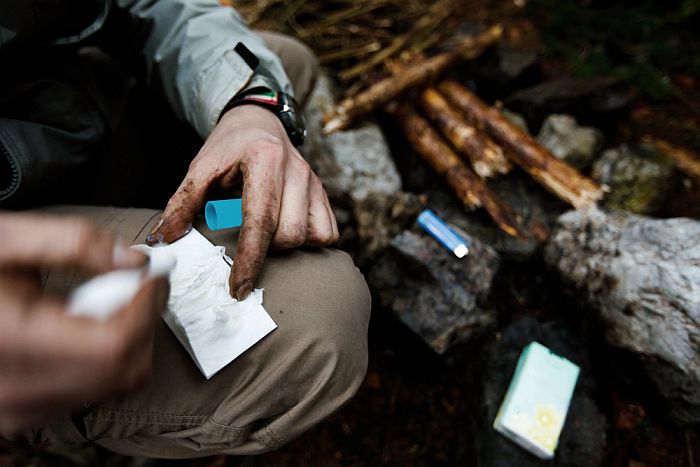
One of the oldest and most reliable field hacks is combining chapstick with cotton. Chapstick is basically wax and oils — exactly what fire loves. Rub a bit into a cotton ball, twist the fibers slightly, and light it. The flame burns hotter and longer than cotton alone, even in wind or damp conditions.
If you don’t have cotton balls, the lint from your pockets or pack works too. Chapstick turns weak tinder into real ignition fuel, buying you the precious seconds you need to get your fire started when it counts.
Knowing this trick removes half the stress of wet-weather fire building.
3. Turn a Trash Bag Into Useful Shelter
A simple contractor-grade trash bag weighs almost nothing, but it’s one of the most useful emergency items in the world. Split it open and you’ve got a small tarp. Keep it intact and it becomes a rain poncho. Fill it with leaves and it becomes insulation. Line your pack with it and your gear stays dry. Stuff it with snow and you’ve got a collection bag for melting water.
In emergencies, moisture is often the real enemy — not cold by itself. A trash bag keeps your core dry, traps warm air, blocks wind, and buys you time to stabilize your situation. It’s one of those items that feels ridiculous until it saves your night.
4. Use Duct Tape for Fast Repairs — and Real Medical Fixes
Duct tape doesn’t look like survival gear, but it absolutely is. Tent rip? Duct tape. Torn jacket? Duct tape. Broken pole, loose boot tread, ripped pack strap, cracked water bottle? Duct tape.
But the medically useful part is what surprises people. Duct tape can close small cuts, secure bandages when nothing else sticks, hold a splint in place, create a butterfly closure, prevent blisters, and even form a makeshift sling in a pinch. It’s basically the Swiss Army Knife of adhesives.
A small roll weighs almost nothing and turns dozens of “trip-ending problems” into “minor inconveniences.”
5. Create an Emergency Water Filter With Clothing and Sediment Layers
If your only available water source is full of debris, clothing becomes an instant pre-filter. Pour water slowly through a bandana, shirt sleeve, or sock to remove sediment before boiling or purifying. If you can layer gravel, sand, or charcoal in a container, even better — the clearer the water starts out, the easier and more effective your purification step becomes.
Remember: filtration is not purification. The goal here is to remove visible junk so your next step can kill what you can’t see.
If you’ve ever tried treating water while tired, sick, or injured, a gravity-fed water purifier feels like magic. You fill the top reservoir, hang it, and let time do the work. No pumping. No squeezing. No effort. It’s the perfect companion to DIY filtration when you want real hydration without burning energy.
6. Use a Flashlight and Water Bottle as an Area Lantern
If you need broader lighting instead of a narrow beam, turn your flashlight into a lantern: aim the beam into a translucent water bottle and the entire bottle glows. Suddenly you’ve got ambient light for cooking, sorting gear, or building shelter without blinding yourself with a direct beam.
This hack works with headlamps too — just strap the lamp around the bottle with the light facing inward and the whole thing becomes a soft, diffused lantern.
If you want to upgrade later, this is where a rugged rechargeable camp flashlight fits naturally into your kit. Some models throw a massive beam, hold power for absurdly long runtimes, and survive being dropped, rained on, or frozen. They also double as power banks, letting you charge your phone or GPS during emergencies. It’s one of the rare “fancy” items that genuinely improves a survival setup because reliable light never stops being a priority.
7. Use a Carabiner and Cordage to Build All-Purpose Tools
With just a bit of cord and a carabiner, you can improvise gear you didn’t know you needed: a bear bag hoist, a clothesline, a gear drag, a makeshift harness, a pot hanger over the fire, or a backpack repair strap. Cordage and a clip multiply what you can build from almost nothing.
You don’t need high-end rope — even simple paracord handles the majority of tasks. Carabiners turn knots into quick-connect systems, reducing setup time and making everything easier to manage with cold hands.
Once you learn how to combine cordage and clips, the outdoors becomes a big toolbox instead of a problem.
Final Thoughts
Survival isn’t about having the most gear — it’s about using what you already have in smarter ways. Everyday items can keep you warm, hydrated, lit, sheltered, and stable in situations where specialized equipment might not even be available. A metal can becomes a stove. A smear of chapstick becomes fire fuel. A trash bag becomes shelter. Duct tape becomes structural support. Clothing becomes a filter. A water bottle becomes a lantern. Cordage becomes whatever tool you need it to be.
And when you combine these hacks with a couple pieces of dependable gear — like a gravity purifier for effortless safe water or a durable rechargeable flashlight that won’t die when you need it — your margin for safety grows even wider.
The best survival kit isn’t the most expensive one. It’s the one built from knowledge, improvisation, and a few tools used intelligently. The outdoors rewards creativity, and these hacks turn ordinary items into extraordinary solutions when things take an unexpected turn.